This is going to be even messier than usual and probably won’t be worth reading until tomorrow.
Alongside Motown, the Beach Boys, Alfred Hitchcock, Cary Grant and chocolate milk, detective novels were one of my earliest and most enduring loves.* I read the usual suspects as a child: Nancy Drew, The Boxcar Children, musty old Agatha Christie BCEs bought two (sometimes four!) for $1.00 at used bookstores and regional book fairs.** By middle school I’d graduated to Michael Connelly and Patricia Cornwell, which I compulsively read between and during classes — after turning in tests and completing assignments, of course. Sometimes I lingered after the dismissal bell to trade recommendations with Mrs. S., a history teacher who initiated our friendship by nodding approvingly when she spotted the cover of From Potter’s Field and remarking “That’s a good one.”**
Was that the era of Cornwell’s tweed jacket? I stopped reading her Scarpetta books around the time she made two creative changes I couldn’t abide — experimentation with third-person narratives and Lucy’s heterosexual fling with Rudy — and gave away my collection to clear shelf space. But there was a hardcover entry in the series that featured an author’s photo I’d once taken as proof of something that seemed glaringly (and excitingly) obvious despite all available evidence to the contrary: Patricia Cornwell was gay as a goose. For all my imagined powers of detection, I’d not yet solved the mystery of my lack of interest in boys, and this obliviousness allowed me to look at that photo and pretend my admiration was purely professional and not a silly crush.
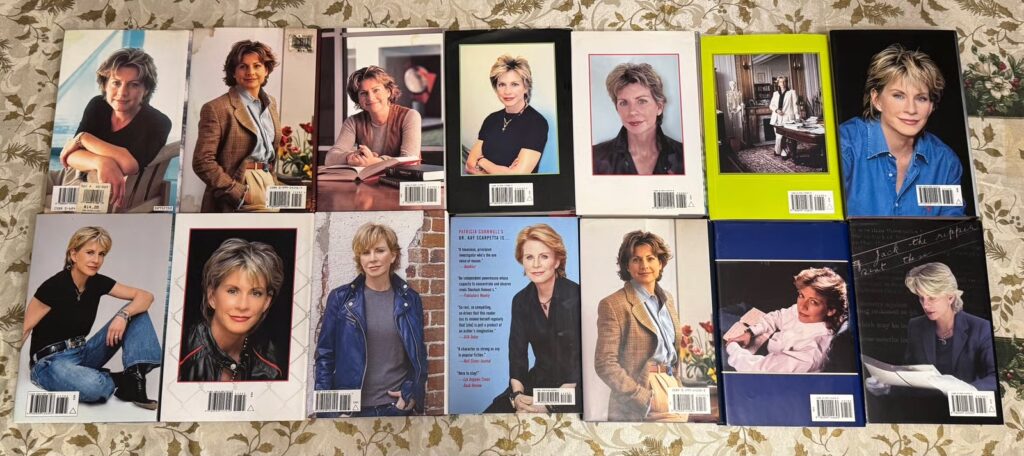
Naturally, Cornwell turned out to be the kind of classically crazy lesbian I did my best to avoid once I cautiously approached the dating pool and realized there were no lifeguards on duty. There were rumors she stalked Jodie Foster (this might come up here again in the future if Foster’s son is really involved in the upcoming Scarpetta series) and the Margo Bennett saga made tawdry tabloid headlines. She sunk millions into promoting a dubious Jack the Ripper theory and began mutilating her face; she spent a few years looking like Reba McEntire’s motorcycle enthusiast lesbian sister. But I still remember that photo and those early Scarpetta books fondly, even if I’m not sure I’d want to reread them.
I’ve wandered too far off-track to pull this together before bed and get to everything else I wanted to cover, but the gist of it is this: I went looking for a new mystery series to read earlier and encountered an unfamiliar name: Freida McFadden. Her books are standalone thrillers that I overlooked in selecting The Neon Rain, the first in James Lee Burke’s acclaimed Dave Robicheaux series. But the frequency with which her work was recommended piqued my interest and I looked her up. Was she really that good or had she merely gamed Amazon’s algorithm? McFadden, I soon learned, is immensely popular and so prolific that there are rumors she uses A.I. and blatant plagiarism to maintain her frenetic publishing pace.
McFadden’s a strange character herself: a physician who writes pseudonymously and publishes four or five new books per year while raising a family and seeing patients a day or two per week. She prefers online appearances to in-person signings and seems to disguise her appearance with wigs, a charge she denies. After reading speculative fan discussions about her true identity, including healthy skepticism from critics who doubted it was humanly possible to juggle her personal and professional obligations, I decided to do some sleuthing of my own. Her artistic trajectory and the timeline of her residency made one thing very clear: she definitely wasn’t a neurologist, the specialty her fans mentioned most often based on what she shared about her work.^
It took a couple hours to piece everything together, which is how I wasted this evening, but it was alarmingly easy to identify Freida McFadden. If I wasn’t so personally invested in physician privacy, I might write a Cornwellian mystery — or a Case Closed tome — about it.
* Grant’s screwball comedies (and the occasional tearjerker) were where he really got me, not the films he made with Hitchcock. His work with Ingrid Bergman in Notorious will make you weak in the knees and North by Northwest is a rightful classic, but To Catch a Thief‘s a dud and the framed Suspicion advert in my office is only an endorsement of its artwork.
** X-Files novelizations were a go-to between mysteries, but those were limited in quantity in the mid-’90 so I usually slummed it with Mary Higgins Clark mysteries, The Bone Collector, Kiss the Girls, and whatever else was readily available.
^ Very few specialties leave residents with enough time to be as busy with non-medical pursuits as she was during that period, and fewer still allow you to subspecialize in treating brain injury. Neurosurgery and psychiatry were equally implausible for the same reason.