One of my weekly routines is to browse the Kindle Sales page on Amazon, looking for library inspiration.* If you can wade past all the Kindle Exclusive junk on offer — werewolf porn, Gone Girl knockoffs, hockey smut (gay or straight, puck and stick puns abound), get-rich-quick schemes — you’ll find more interesting titles than library e-book apps promote. Some of it is curated based on your browsing and purchase histories, which explains the hardboiled European mystery series, new translations of Russian classics, and reissues of biographies about obscure Hollywood figures I’m served. Other selections are universal.
Beach reads are everywhere you look this time of year, so I almost scrolled past “Breezy Page-Turners” and missed the opportunity to titter at the inclusion of Pat Conroy’s Prince of Tides.
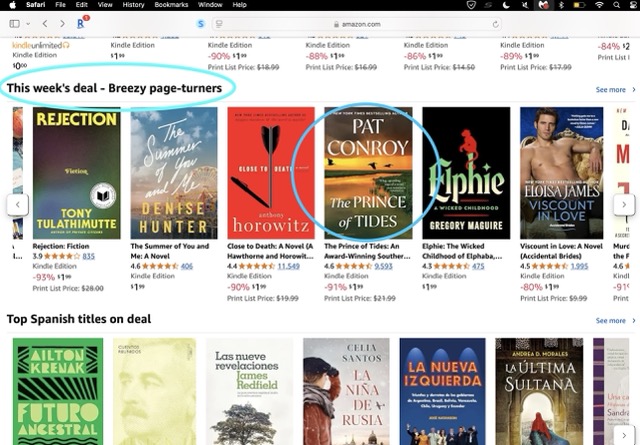
If you’ve read The Prince of Tides or seen the movie, you know it isn’t breezy.** (Calling it a page-turner is also a stretch, but I’ll let that go since it’s open to debate.) Did a human with a morbid sense of humor choose its category, or was an algorithm confused by its title and cover? A few weeks ago, while cleaning the bathroom, I succumbed to an algorithm myself and listened to a YouTube video about adulting coloring books and overconsumption trends on BookTok. It was suggested because of overconsumption videos I’d previously watched and the clickbait worked: I wanted to know why people are spending hundreds of dollars on special markers to color sheets in $5 books.
Once my ignorance of BookTok was punctured — it’s the domain of TikTok influencers who’ve conspired with publishers to ruin reading (and apparently coloring) the way they’ve ruined everything else — the floodgates opened. From there I learned of BookTube, or book talk videos on YouTube. I’ve only watched a video or two per day since then, ranging from 2 to 10 minutes long, and listened to a couple of 20 minute videos while doing yard work. Some were stopped early when I couldn’t take the presenters, obviously hadn’t read what they yapped about, seriously. One of the worst offenders was also among the most popular: Jack Edwards, a cute, charismatic and suspiciously well-groomed British guy with several channels.^
Many of these ‘creators,’ as they’re known, have worked in libraries or bookstores; some are aspiring authors or failed academics. Maybe they started off with the purest of intentions and lost their way as their channels grew, or maybe some were disingenuous from the start. All I know is that anyone who has actually read a novel is capable of discussing it directly, without dancing around its themes, influences, and implications like a lazy grade-schooler faking their way through a book report.^^ Yesterday, as I folded a mountain of laundry, I finally found someone whose perspective seemed genuine. Man Carrying Thing is a YouTube channel better known for humor videos, but his enthusiasm for Lawrence Block and Robert Parker was a breath of fresh air. I’ll return to his book-centric playlist next time I scrub a toilet, and there’s no higher praise than that.
* If you’re anti-Amazon, Kobo usually has some of the same titles (minus Kindle exclusives) on sale for identical prices. I don’t have a Kobo e-reader but there’s a free app you can use on other devices.
** Unless you’re Crankenstein, who has seen shockingly few Barbra Streisand films and acts like she’s being tortured if I suggest watching one.
^ I almost choked when he mentioned a girlfriend, for reasons that will be clear to you once the algorithm serves you his videos.
^^ The more voraciously you read, the more incisive your commentary should become. Some of these people claim to read 150 to 200 novels per year, but they’ll speak vaguely of a single book for 10 minutes without referencing other books (even those by the same author) or writers. It’s very odd.